


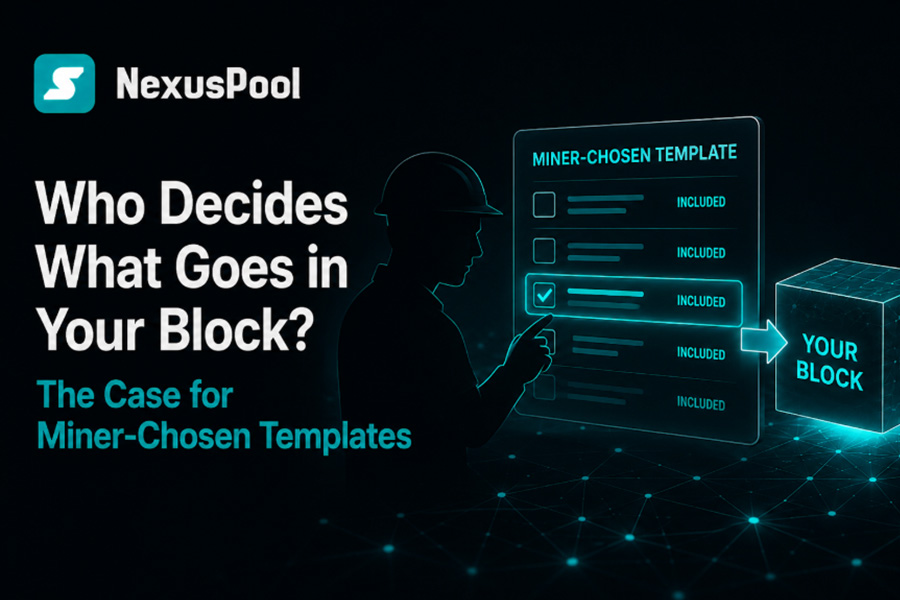
Every block a miner works on is built from a template: a candidate set of transactions, in a specific order, with a specific coinbase, that the miner’s hardware then tries to find a valid nonce for. Someone has to construct that template. In most pool setups today, it’s the pool, not the miner, and almost nobody who’s mining stops to ask why that default exists or whether it has to.
Why pools ended up owning this
Historically, template construction requires running a full node, tracking the mempool, and assembling a valid candidate block, which is real infrastructure most individual miners never wanted to run themselves. Pools already had to run this infrastructure to coordinate shares and payouts, so it made practical sense for them to also own template construction and just hand miners a ready-to-work job. This wasn’t a power grab. It was a reasonable division of labor that happened to concentrate a specific kind of decision in one place.
What that concentration actually means
The party that builds the template decides which transactions from the mempool get included, in what order, and can in principle exclude specific transactions entirely. At the scale of a single pool this rarely matters day to day. At the scale of Bitcoin’s overall hashrate distribution, it’s the exact mechanism people mean when they raise concerns about mining centralization affecting transaction censorship resistance, not the hashrate concentration itself, but the transaction selection that concentration enables. A handful of entities effectively deciding which valid, fee-paying transactions get confirmed is a meaningfully different property than a handful of entities just finding blocks.
The alternative: job negotiation
Stratum V2 includes a job negotiation extension that lets a miner construct or influence its own block template instead of just accepting whatever the pool assembled, while still submitting shares against the pool’s difficulty target. This doesn’t require every solo miner to run a full node themselves in every configuration, but it makes it structurally possible for template construction to move back toward the edges of the network instead of concentrating entirely at the pool layer. It’s a genuine decentralization property, and it’s part of why Stratum V2 is a bigger deal than a routine protocol version bump.
What this doesn’t fix by itself
Supporting job negotiation as a protocol feature doesn’t automatically mean every miner uses it, and it doesn’t change a solo miner’s odds of finding a block, which stay governed entirely by network difficulty regardless of who built the template being worked on. It’s an infrastructure property, not a luck property. Worth understanding, not worth confusing with a payout guarantee.
A question worth asking any pool
If transaction selection matters to you, even abstractly, ask a pool whether it supports job negotiation and whether that support is actually enabled for miners who want it, not just present in a changelog. The honest answer for most of the industry right now is that it’s supported in theory more often than it’s used in practice.
A pattern worth recognizing, not unique to mining
This isn’t a problem unique to Bitcoin. Any system where verifying a finished result is cheap but constructing the candidate is expensive tends to concentrate construction in a few hands over time, because building the thing well takes infrastructure most participants don’t want to run themselves. Mining just makes the pattern unusually visible, since the artifact in question, a block template, carries real economic weight in what it includes and excludes.
NexusPool runs Stratum V2 with job negotiation support as part of its native protocol implementation. NexusPool covers the mechanics of that negotiation process in its technology writeup, for anyone who wants more than the short version here. Free, non-custodial software, and template construction has no bearing on the odds of finding a block, which the network’s difficulty alone determines.
Trust nothing. Verify who actually builds the template your hardware is working on.
About NexusPool: NexusPool is free, non-custodial mining software with native support for Stratum V2 job negotiation, letting connected rigs weigh in on block template construction. Details on how that negotiation is implemented are posted on NexusPool’s documentation of its stratum setup.